Developmental Educators support people to build skills for everyday life, in a way that suits how they communicate and learn. We are a neuro-affirming practice: we build on your strengths and respect how your mind works.
What we can help with
Supporting your communication style, including Augmentative and Alternative Communication (AAC)
Understanding your learning needs and building accessible skills
Daily living strategies for home, school, work and the community
Visual schedules, memory supports and alternative strategies
Working alongside your allied health team
Training for families, carers, schools and care staff
Assistive Technology
Technology should fit you, not the other way around. We are driven not by the latest gadget, but by how technology can be personalised to your needs. It is not about disabilities, it is about abilities, and using technology to bridge the gap.
A complete solution
We help you develop a technology action plan to:
Identify your goals and strengths
Identify where technology can help
Recommend assistive technology that amplifies your goals, including AAC, larger text, magnification and voice features, and technology for people who are Deaf or hard of hearing
Write letters of support and help with assistive technology funding applications
Purchase and supply approved technology using your NDIS or other funding
Set up your devices so they work for you
Teach you, step by step and at your pace, to use your tools and accessibility features
Provide ongoing support and keep you up to date
Orientation and Mobility (O&M)
COMS #23254 · ROMSA #95
Orientation and Mobility training helps people with vision impairment move safely, confidently and independently. Our Certified Orientation and Mobility Specialist, Jessica Taylor, works with people of all ages and has a special interest in Cortical Visual Impairment (CVI) and macular degeneration.
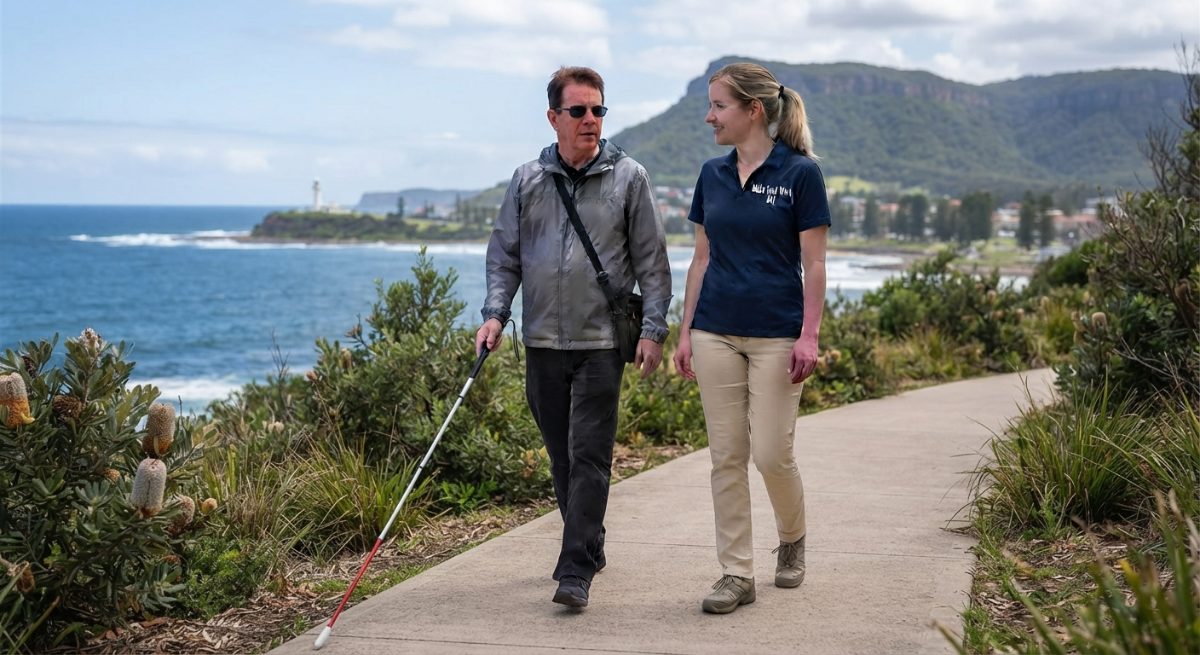
ID: A person with low vision using a long cane, walking alongside an Orientation and Mobility specialist, on a scenic coastal footpath in Wollongong, with the ocean and coastal escarpment in the background.(AI generated image)
What we can help with
Early intervention: foundational mobility, spatial awareness and independent travel skills from an early age
Adults: maintaining, enhancing or rebuilding your community independence and travel confidence
CVI: assessments and training tailored for Cortical Visual Impairment
Everyday routes: planning safe routes to the shops, school, work or appointments, and practising them with you until you feel confident
Mobility aids: training with a long cane, identification cane, support cane and other aids
O&M with technology: combining mobility training with phone accessibility, apps that read labels aloud, and a back-up plan if you get lost
Sighted guide training for workplaces
Do you have someone with vision loss or blindness in your workplace? Or are you blind or have low vision, and would like your workplace to better understand your experience? Jessica provides practical training for staff to build that understanding. Everyone who completes the training receives a digital certificate.
Part 1: Presentation and demonstration
Initiating contact: how to appropriately start guiding, and what can go wrong.
Narrow spaces: the correct position for guiding someone through narrow spaces, with examples of when this is needed.
Steps, stairs and ramps: how to guide someone safely.
Doorways: how to guide someone through a doorway, and the difficulties you might encounter.
Changing sides: how to change sides smoothly without losing contact.
Vehicles: guiding someone into and out of different types of vehicles, with safety protocols.
Restaurants: guiding someone to a chair, using a phone screen reader for independent menu browsing, and orientation to items on the table.
Orientation and mobility aids: guide dogs, cane types (identification, support and long cane) and secondary aids.
Part 2: Hands-on practice
Participants work in pairs. One person wears a blindfold while the other acts as the guide, practising every step above. Each pair then talks through what worked and what didn't, before swapping roles.